
A Group Street Kart Tour in Shibuya When Language Is a Worry: How Much Prep Can You Skip?
A Group Street Kart Tour in Shibuya When Language Is a Worry: How Much Prep Can You Skip?
"My English isn't that great. Will I be okay?"
If someone in your group isn't confident in English, you may hear this while you're planning a street kart tour in Shibuya. Once one person says it, the others start to wonder too. Before long, someone is making a phrasebook, everyone is installing several translation apps, and people are practicing Japanese greetings. That's understandable. Everyone gets a little anxious the night before a trip.
Still, a lot of that preparation isn't needed. Some of it, though, will cause trouble on the day if you skip it. So where should you spend effort, and where can you relax? Let's go through it step by step.
Start with this: What language is the tour in?
The first thing to know is that Street Kart tours are generally guided in English. Whether you can get guidance in Japanese or another language depends on the staff working that day. It isn't guaranteed.
It helps to take stock of your group's language situation now. Can everyone get by in English? Is there anyone who struggles with it? If so, how many people, and who should they stay near so they feel at ease? That's all you need to know. You don't need to test anyone's language skills.
If a member isn't confident in English and really needs guidance in their native language, contact the official support channels early. Keep in mind, though, that asking doesn't guarantee the language on the day. Asking on the day "Do you have staff who speak this language?" gets you the same answer: it depends on who's working.
If someone's English is just "a bit weak," I don't think there's much to worry about. A guide leads the way and you drive behind them. Having a member who understands English nearby makes a big difference to how people feel.
Before you set off, there's a safety briefing covering how to operate the kart, the route, and things to watch out for. Assume this will be in English too, and agree on one thing as a group: after the briefing, a member who's good at English sums up the key points in the group's language. That summary is only a backup, though. Everyone still needs to confirm they understood the controls, the route, and the precautions, and ask the guide about anything unclear. Don't skip that part. Hearing the parts you missed again from a friend helps you settle down before you take the wheel.
If something is still unclear, feel free to ask the guide to repeat it. You only need two English phrases for that: "Could you say that again?" and "Could you show me?" For the controls, having the guide show you is sometimes faster than an explanation. On the day, having these two phrases saved in everyone's phone notes will probably help more than a whole phrasebook.
Also worth knowing: the Street Kart website is available in 22 languages. Each person should check ahead of time whether one of those 22 languages is one they can read.
But those 22 languages apply to the website you read beforehand. The guidance on the tour itself is a separate matter. Mix the two up and you'll end up with small misunderstandings on the day.
Prep you can skip, and prep you shouldn't
Let's start with what you can let go of.
First, memorizing Japanese phrases for the tour. Since the guidance is generally in English, there's little reason to learn Japanese driving terms or how traffic rules are phrased. That said, it's nice to know "thank you" and "excuse me." The person behind the counter at a Shibuya café might give you a small smile. That's part of the fun of sightseeing, and it has nothing to do with kart prep.
Next, getting the whole group on the same translation app. Whatever each person usually uses is fine. Two other things matter more: checking that your phone has a data connection before you leave, and agreeing as a group that nobody touches their phone during the tour so everyone can focus on driving. Translation apps are for before and after the tour, like reading a menu at a restaurant or figuring out a map.
Also, the organizer doesn't have to explain everything to everyone. Let that go too. Assume each person reads the website on their own, and the organizer just checks with a quick "Did you read it?" Nobody wants to see the organizer completely worn out by the end of the trip.
On the other hand, don't skip checking driver's licenses. This is the one thing the group can't handle all together, because what you need depends on the country that issued your license and its type. The details are on the driver's license page of the official website. Each person should read it and prepare whatever applies to them. That page is also the most reliable place for the latest requirements.
Showing up thinking "it'll probably be fine" and then not being allowed to drive is the biggest waste of all. You came with your friends, and you end up waving them off from the shop. Nobody wants that.
There's one more thing the whole group should get right, and it has nothing to do with language: what you wear. Wear closed-toe shoes, ideally sneakers. Wear comfortable clothes you can move in, like jeans or casual wear. Avoid open-toe shoes, heels, skirts, and dresses. Post this once in the group chat the day before, and nobody will be scrambling at the shop that morning over "Are those shoes okay?" In summer, add hats, sunglasses, and sunscreen to the list.
Talk about luggage ahead of time too. The shop has lockers for small items, but they're not meant for large bags like suitcases. If you're joining the tour on a travel day, drop your large bags at the hotel before you come. If even one person shows up pulling a suitcase, the whole group's schedule can fall apart.
Keep language prep light. Do the paperwork carefully, for every single person. For a group, I think that's the right balance.
Handle booking and scheduling in writing
When language is a worry, people often overlook how they'll contact the company. Street Kart accepts bookings via Facebook, LINE, and email.
The advantage of communicating in writing is that you can take your time. You can run replies through a translation app or have a member who's good at English look them over. You can reread your own message as many times as you want before sending it. That feels very different from a conversation where you have to understand on the spot and answer right away.
When coordinating the group's schedule, I recommend picking several possible dates before you reach out. The bigger the group, the fewer days that work for everyone. Weekends tend to book up, so if some members are only free on weekends, start early.
The simplest way to collect dates is to have everyone write "I can go on these days" in the group chat. If someone is slow to reply, set a deadline. That settles things much faster than the organizer chasing people one by one.
Also, choose one person as the point of contact. If several members contact the company separately, details can conflict and the same question may arrive multiple times. Ideally the contact person is good at writing in English, but it's fine if they aren't. Write short sentences with the number of people, your possible dates, and what you want to confirm. If you say it clearly, it'll get across.
In your first message, include the number of people, your possible dates, and the fact that you want the Shibuya location, plus the country that issued each member's driver's license. Be careful here: the organizer shouldn't fill in the issuing countries by guessing. Even friends from the same country may have gotten their licenses in different countries. Ask each person and write down exactly what they tell you. It's a small effort, but it cuts down on back-and-forth later.
If you're curious how group size is handled or about other specific conditions, ask while you're inquiring about the booking. Asking first leads to fewer surprises on the day than building a plan on your own assumptions.
On the day in Shibuya: How not to get lost meeting up
Sometimes the language worry is bigger for getting to the tour than for the tour itself. That's especially true in Shibuya.
The Shibuya shop and Shibuya Annex are in almost the same spot. The nearest station is Shinsen, about a 5-minute walk away. From Shibuya Station it's about a 10-minute walk. The shop has no parking, so use public transportation.
For the group's meeting point, I think it's safer to pick somewhere near the shop or Shinsen Station rather than inside Shibuya Station. Shibuya Station has many lines and many exits. If you're not used to the signs, you can lose a lot of time just looking for each other. The Hachiko statue is a famous meeting spot, but that also means it's crowded. Finding everyone there with a big group is hard work.
On the morning of the tour, post the shop's map in the group chat again. That alone will cut down a lot of "Where are you?" messages. If people save the shop in their map apps, they can walk there with the map in their own language, which should make things a little easier.
Decide ahead of time what happens if someone is running late. For example: "If you're going to be late, post in the group chat. The contact person handles all communication with the shop." That way, a member who isn't confident with the language doesn't have to deal with the shop alone.
The same approach works if the weather turns bad. In light to moderate rain, the tour runs as scheduled and raincoats are provided. In heavy rain or a typhoon, the tour may be canceled. On days with rain in the forecast, make checking for messages from the shop part of the contact person's job. Just tell everyone else, "Weather updates will go in the group chat too," and no one will be left trying to decode an English message alone.
If you have time, walking around Shibuya before or after the tour works well. Shibuya Crossing and Center Gai are within walking distance of the shop. Head toward Dogenzaka and you'll find plenty of places to eat. Leave extra time before the tour for meeting up, and save the detours for afterward. For a group, I think that order makes timing easier to manage.
Street Kart's appeal, seen with less language worry
That's been a lot about preparation, so let's get to the experience itself. When you have one less thing to worry about, you start noticing different things.
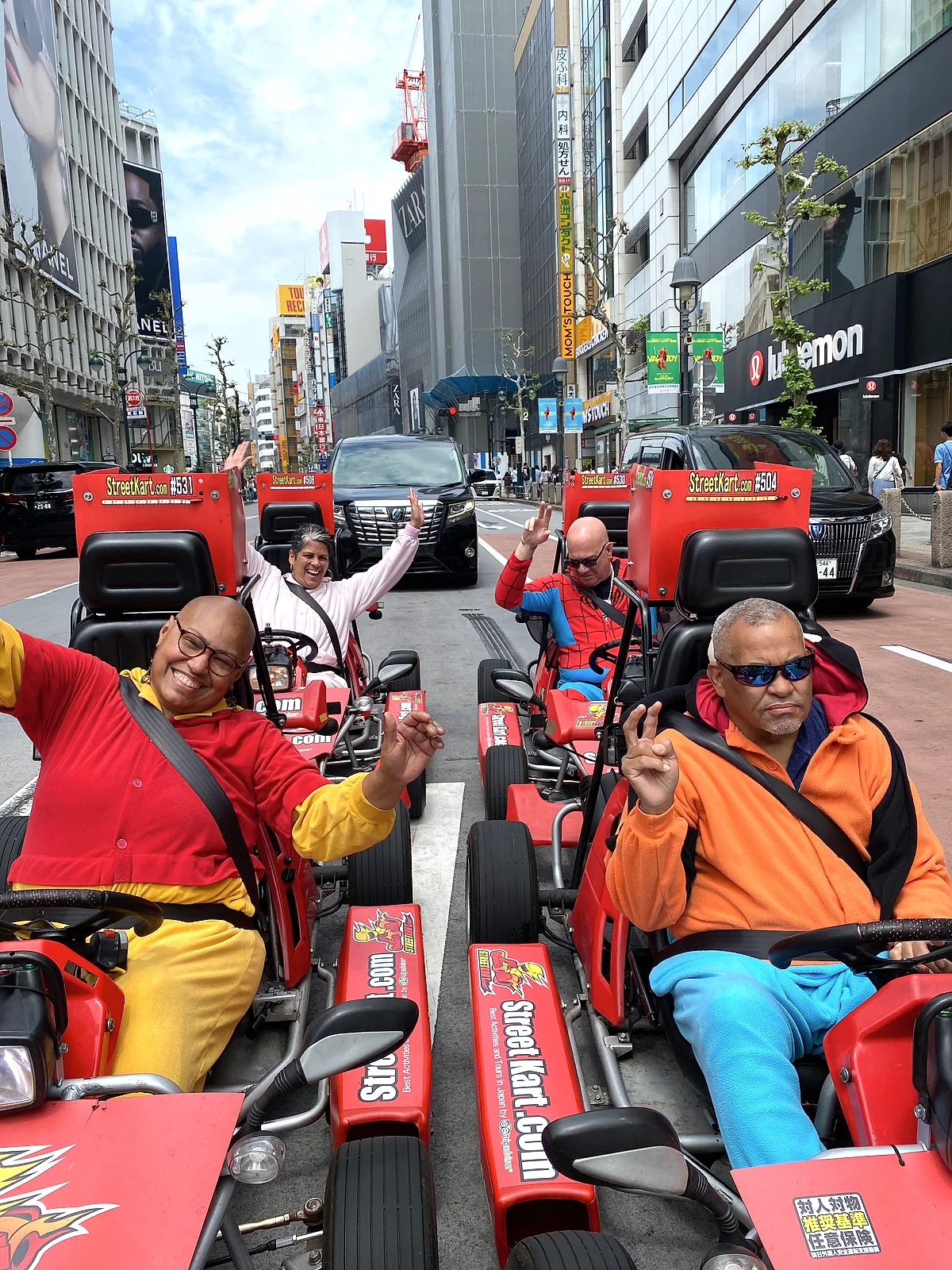
First, a guide leads the way. On every tour, a trained guide drives in front. Memorizing roads and reading maps isn't your job. Even if you don't know Tokyo's streets, you can follow the guide and drive through Shibuya's scenery.
Second, the route is set in advance. You don't choose where to go on the spot, so the group doesn't have to debate "Where should we go?" The Shibuya tour takes you past sights including Shibuya Crossing, the zelkova trees of Omotesando, and the area around Harajuku's Takeshita Street. Names you know well go by one after another beyond the steering wheel.
Third, you're close to the city. Looking up at Shibuya from a kart is different from seeing it on foot or through a car window. You wear a helmet and goggles and look up from a low seat at the walls of buildings. You feel the wind on your face. You hear the city's buzz while you wait at a light. Crowds of people cross right in front of you. To exaggerate a little, it feels like you can hear the city breathing right next to you.
Fourth, everyone takes home the same experience. The karts are single-seaters, and passengers aren't allowed. So everyone takes the wheel. Nobody is split into drivers and passengers. After the ride, everyone can talk about the same moments: "That intersection was amazing!" If you're coming with friends, this might be the best part.
Keep your prep light and go drive Shibuya
When language is a worry, you can prepare forever if you aim for perfect. So draw a line. Put off memorizing Japanese. Let everyone use their own translation app. Have each person check ahead of time whether the website's 22 languages include one they can read. In exchange, each person checks their own driver's license carefully. For booking and communication, pick one point of contact and handle things in writing.
What to check the night before fits in a short list. Do you have your physical paper driver's license with you, not a digital one? Are you wearing closed-toe shoes? Have you arranged to leave large bags at the hotel? Are the two English phrases for asking again saved in your phone notes? Each person checks these four things for themselves. The organizer doesn't need to go around checking everyone.
Cover these points and the organizer's load gets much lighter. You can also give members who aren't confident in English something specific: "Just check these things." The trick is simply to swap a vague worry for a short to-do list.
Weekends tend to book up, so if you're aiming for one, get in touch as soon as you've settled on possible dates. Bookings are accepted via Facebook, LINE, and email. Contact details and the latest information are on the Street Kart official website.
First, drop this link in your group chat.
Then on the day, follow your guide out into the Shibuya wind.
This article was originally written in Japanese and translated using AI. Some expressions may read unnaturally, and we appreciate your understanding. For the most accurate and up-to-date information, please refer to the official site at kart.st.
Street Kart is not affiliated with Nintendo or the Mario Kart series in any way. We do not provide costumes of Nintendo characters, and such costumes may not be worn during tours even if brought by participants.