
Shibuya in Peak Season vs. Off-Season: How the Scenery Changes, How to Coordinate Group Dates, and Street Karts
Shibuya in Peak Season vs. Off-Season: How the Scenery Changes, How to Coordinate Group Dates, and Street Karts
It's early on a Sunday afternoon, and the light at the Scramble Crossing turns green. People step off the curb from every direction at once, and the whole intersection becomes one big wave.
On a weekday just after the rain, it's a different story. What you notice isn't the people. It's the neon reflected on the wet pavement.
Shibuya turns into a different city depending on when you come.
This article is for groups who are visiting Tokyo together and planning to ride a street kart in Shibuya. It looks at how the city changes between peak season and off-season, and it also lays out the planning steps for getting a big group onto the same schedule.
In peak season, the crowd itself is the view
When a weekend overlaps with one of Japan's major holidays, Shibuya never stops moving. People wait for friends around the Hachiko statue, and groups carrying shopping bags wait for the light in front of SHIBUYA109. Look down on the crossing from above and the flow of people seems to trace out patterns.
At this time of year the whole city runs hot. There's plenty of energy, but it's hard to move on your own timing, and harder still with a group.
On crowded days, the people take over from the buildings as the main feature of the scenery. Shibuya Scramble Square and Shibuya Hikarie are standing right where they always are, yet what you actually notice is the stream of people, the chatter, and the music drifting out of the shops. If you came to soak up the buzz, Shibuya in this season will give you plenty of it.
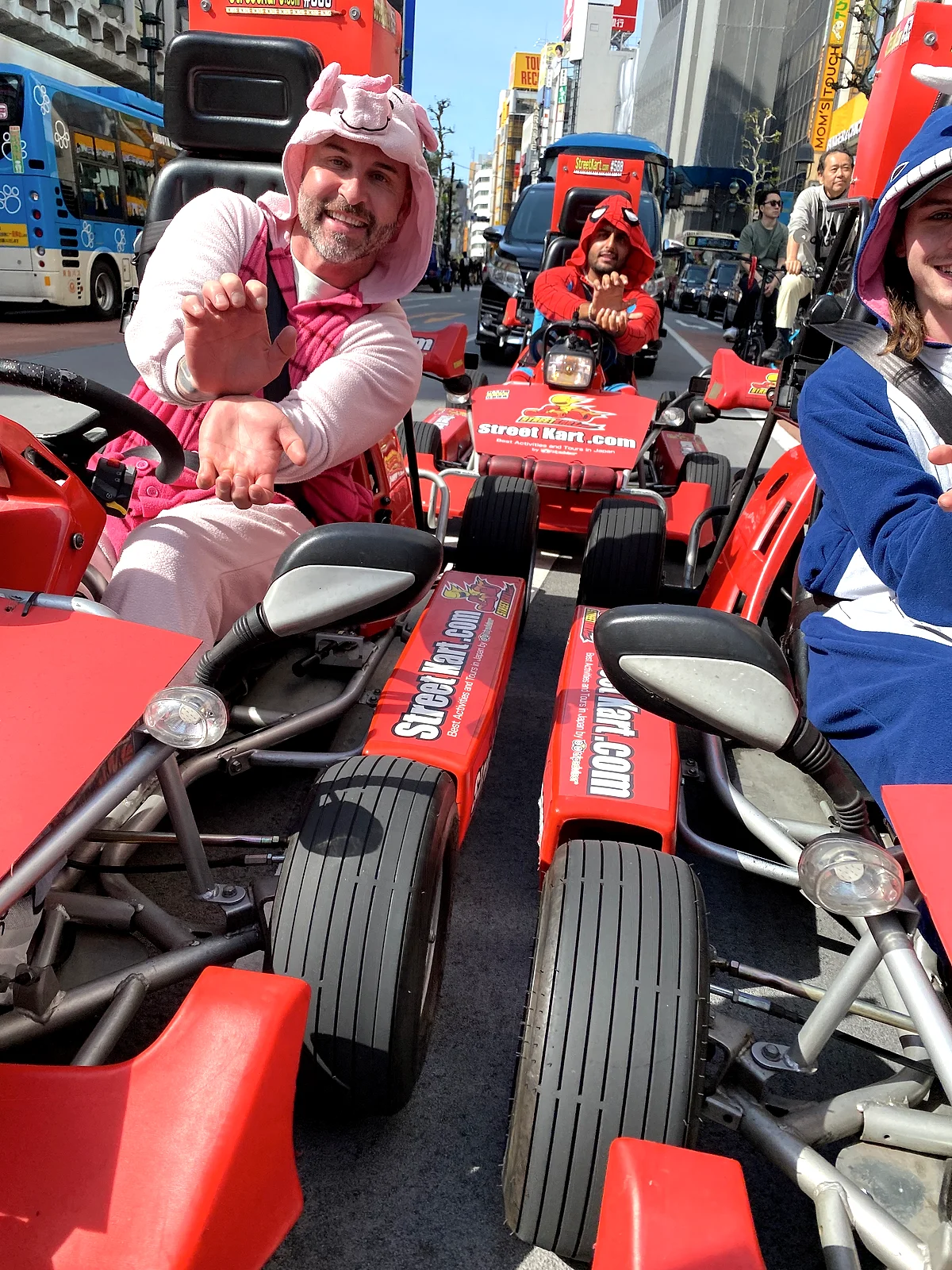
Some Shibuya store tours run from the Scramble Crossing through Dogenzaka and on toward Omotesando and Harajuku. Watching the crowd from the sidewalk and looking up at it from low down on the roadway feel completely different, even at the same intersection. These are public roads, of course, so traffic lights and traffic rules apply as usual. You follow the guide's instructions and keep a safe distance from the kart in front. For the route, just follow the guide ahead of you. On busy days pedestrians are harder to predict, so save the sightseeing for red lights. That seems about right.
If your tour runs into the evening, the screens on the buildings and the shop signs start lighting up, and the crowd takes on different colors than at midday. Even on the same weekend, an afternoon ride and an evening ride show you two different Shibuyas.
Weekends do take a bit more care when booking. More on that in the scheduling section below.
One more thing: Street Kart stores have no parking, so please come by public transit. The Shibuya store and Shibuya Annex are in almost the same spot in Maruyamacho, a 5-minute walk from Shinsen Station on the Keio Inokashira Line and a 10-minute walk from Shibuya Station. On a crowded day, meeting up on the Shinsen side may be easier than trying to find each other outside the Shibuya Station ticket gates. Up to you.
Before departure there's time set aside for check-in and a safety briefing. On busy days, even the walk from the station to the store can take longer than you'd expect. Leave yourself plenty of time so you're not rushing in right at the meeting time.
In the off-season, the outline of the city comes into focus
On weekdays away from weekends and holidays, Shibuya calms down a notch. With fewer people at the crossing, things that were hidden behind the crowd come into view: the shape of the traffic lights, the videos playing across building walls, the angle of the slopes. You can also feel in your legs that Shibuya is built in a valley, and that's easier to notice on quieter days.
On a quiet day, Shibuya becomes a chance to take in the city's bones.
From a kart, you feel those bones even more directly. Sitting low on the roadway, you feel the tilt of each slope in your body. Ups and downs you'd never notice on foot come through your back and the steering wheel. When you stop at a light, you get a clear view of the buildings lined up across the intersection and the road climbing up the hill. In peak season you look up at the crossing over a sea of people. On a quiet day, you look up at the whole outline of the city.
The best thing about the off-season is that you can take in the scenery at your own pace. On group trips, it often turns into a cycle of someone taking photos while everyone else waits. With fewer people around, there's more room to stop, and both the ones waiting and the one being waited for can relax a little.
That said, weekdays aren't guaranteed to be quiet. Don't assume you can just book on the day because it's a weekday. Get in touch as soon as your dates are set. That level of caution is about right.
Your chosen day might also turn out rainy. In light to moderate rain, tours go ahead as planned and raincoats are lent out free of charge. Tours are canceled in heavy rain or typhoons.
Pavement after rain may look beautiful, but it isn't as grippy as on a dry day. Take extra care on wet crosswalk lines and manhole covers. Follow the guide's instructions and plan to leave a little more space between karts, and you'll be able to ride calmly.
Reading the seasons in the zelkova trees of Omotesando
If your Shibuya tour takes a course through Omotesando, that's the street where the seasons show most plainly. The zelkova trees lining it look completely different from one time of year to the next.
Spring is when the zelkovas, bare all winter, start putting out new leaves. The pale green deepens day by day, so the same street can look a different color a week later. Mornings and evenings can still be chilly, so it's a good idea to bring a jacket suited to the season.
In summer the leaves grow thick and the whole street becomes a green tunnel. Even on bright days, the leaves cast dappled shadows on the pavement. To be honest, though, midsummer in Tokyo is really hot. Some days are still hot well into September, so don't assume it'll be cool just because it's "autumn." Tokyo heat comes with humidity that sticks to you.
A word on clothing, too. The official guidelines recommend closed-toe shoes, ideally sneakers, and ask you to avoid sandals, heels, skirts, and dresses. In summer, a hat, sunglasses, and sunscreen help too. People tend to pack light for the season, so check in with your group before you leave so nobody shows up with only sandals.
As autumn deepens, the zelkova leaves turn yellow and brown and gradually fall. Watching the street shift day by day from green to gold, you can almost hear the season's footsteps.
In winter only the branches remain, and the sky opens up. Omotesando is also known as a photo spot for its Christmas illuminations, and it looks like a completely different street from the one you see in summer. The wind is cold, so gloves and something to cover your neck will make you much more comfortable.
On a kart, you feel the sounds and the wind of the city much more closely. You take in the season's air directly: the humid heat in summer, the cold wind in winter.
The same Omotesando shows different colors depending on when you come. When your group picks dates, talk about "which color of Omotesando do we want to see?" along with "when is everyone free?" It makes it a little easier for everyone to feel good about the date you land on.
How do you coordinate a big group? Three things to decide first
Traveling with friends is fun, but it also means a lot more decisions all at once. Here are three things to talk through before you try to line up everyone's schedules.
First, choose between peak season and off-season. Do you want to soak up the buzz of a weekend in Shibuya, or take in a calmer weekday Shibuya? If you start collecting possible dates before settling this, the conversation is hard to wrap up. If you go with a weekend, Saturdays and Sundays fill up quickly, so book early. While you wait for every member's schedule to line up perfectly, the open slots may fill up first. If you go with a weekday, check early whether anyone can't get away because of work or travel plans.
Second, have each member check the driver's license requirements for themselves. There are requirements for driving a street kart, and they vary from person to person depending on which country issued your license and which documents you need. Rather than having one person look it all up for everyone, it's more reliable for each person to read the official driver's license page and confirm their own situation. Finding out right before the trip that you're the only one who can't ride is the kind of thing no amount of consoling can fix. Like scheduling, this is something to sort out early. If you don't have the required documents on the day, you can't take part, and you won't get a refund. You don't want the whole group's departure to turn awkward because one person left their papers at the hotel.
One thing groups often overlook is passengers. The karts are single-seaters and can't carry passengers. "I'm not a confident driver, so I'll ride next to someone" isn't an option, so decide in advance who's driving and who'll do something else during the tour. That makes the day go much more smoothly.
Third, pick one person to handle bookings. Street Kart takes reservations via Facebook, LINE, and email. If everyone contacts them separately, the details about headcount and dates can easily get mixed up. Having one point of contact who passes along the number of participants and the possible dates all at once should get things settled faster. When that person gets in touch, they should also ask whether your group can ride on its own and whether the course you want goes through Omotesando. Tours are generally guided in English on the day. Guidance in Japanese or other languages depends on the staff working that day and isn't guaranteed. If you have any language concerns, ask in advance.
When you choose your point person, talk about money too. Payment is in full in advance, and you can pay by credit card through PayPal. Several people can also pay separately using the same payment link. Will the point person cover everyone and get paid back, or will each person pay for themselves? Decide before booking, and you won't end up arguing over the bill after the trip. There are also conditions for cancellations and changes, so make sure everyone knows them.
Once the booking is confirmed, post the confirmation email or booking number in your group chat as well. That way, if the point person is running late or their phone dies, someone else can pull up the confirmation right away.
If you're stopping by Shibuya partway through your trip, think about luggage too. The store has lockers for small items, but they aren't suitable for large bags like suitcases. Plan the order of your movements along with your dates, such as dropping your bags at the hotel before you come.
Before and after the tour, walk and pick up the season
On the tour, you ride behind a guide. If you want to take in the seasonal scenery slowly and on your own feet, walking around before or after the tour is a good idea.
Meiji Jingu is about a 20-minute walk from the store. It's a shrine forest spreading out in the middle of the city, perfect when you want a break from the noise of the crossing. The colors of the trees change with the seasons, so comparing them with the zelkovas of Omotesando is fun too. Walk into the forest and the city noise from a moment ago suddenly feels far away.
If your kart route went through Harajuku, try walking down Takeshita Street afterward. The street that flashed past in a moment from the kart, you now walk at human speed with a crepe in hand. It's the same street, but the signs that catch your eye and the colors of the shopfronts look different.
Yoyogi Park is also about a 20-minute walk away. It's a large green space in the heart of the city, and depending on the season it sometimes hosts flea markets and music events. The buzz there sounds different from the crossing. Whether anything is on varies by day, so check before you go.
If you're going to walk around before the tour, work backward from the meeting time and decide when to head back. Meiji Jingu and Yoyogi Park are each about 20 minutes away one way, so if you linger you can easily miss check-in. You'll probably feel more relaxed saving the longer walks for after the tour.
If you want to look down on the city from above, head to Shibuya Sky, the observation deck at Shibuya Scramble Square, about a 10-minute walk from the store. Knowing Shibuya both from street level and from above makes your memories fit together into one picture later. Going up before or after the tour also changes the time of day you see. Ride in the afternoon and go up in the evening, and you can watch from above as the lights come on in the streets you were just driving through.
One small request. Japanese cities don't have many trash cans, so plan to take your trash with you; a small bag comes in handy. It's the same idea as "Leave No Trace" in the outdoors: leave the place cleaner than you found it. That alone changes how you relate to the city a little.
Before you open the calendar, decide what you want to see
In peak season, the crowd becomes the scenery in Shibuya. In the off-season, the city's outline comes into view. Which is better depends on your group. What matters is talking about which Shibuya you want to see before you line up everyone's calendars.
Once you've decided on weekend or weekday and which season's Omotesando you want to see, have each person check their own license requirements, and have your point person send one inquiry covering your possible dates and whether the course goes through Omotesando. Do it in that order, and things come together more easily, even with a big group.
Booking contacts and the latest information are all on the Street Kart official website. Before your trip, check the official site for the meeting time, how weather cancellations and changes are handled, the passenger rules, how to book, the cancellation terms, and what to bring on the day.
After that, all that's left is choosing what color your Shibuya will be.
This article was originally written in Japanese and translated using AI. Some expressions may read unnaturally, and we appreciate your understanding. For the most accurate and up-to-date information, please refer to the official site at kart.st.
Street Kart is not affiliated with Nintendo or the Mario Kart series in any way. We do not provide costumes of Nintendo characters, and such costumes may not be worn during tours even if brought by participants.